
AI and Founder Bottlenecks: Protect Human Judgment
AI can give a founder capacity back.
But only if it removes the right work.
The goal should not be to automate the founder out of the business. The goal should be to remove unnecessary dependency on the founder while protecting the judgment, authority, relationships, and consequences that still require human responsibility.
That distinction matters.
A founder decision bottleneck forms when too many recurring decisions depend on one person, causing work to wait even when the information needed to move may already exist somewhere else in the business.
AI can help reduce that dependency.
It can gather information faster. Compare options. Organize context. Document recurring reasoning. Prepare decisions. Surface exceptions. Reduce repetitive administrative work.
But AI does not automatically answer the harder question:
Who should actually decide?
That remains an operating question.
And sometimes, the correct answer is still the founder.
The mistake is treating every founder task as equal
When a growing business becomes too dependent on its founder, the common advice is simple:
Delegate more.
Now AI has added another version:
Automate more.
Both recommendations can be correct.
Both can also be dangerously incomplete.
A founder may be spending time on work that should absolutely disappear from the founder's day:
Gathering information
Reformatting documents
Creating first drafts
Searching previous decisions
Building routine reports
Comparing known options
Preparing meeting notes
Organizing follow-up
Documenting repetitive processes
There is very little strategic value in requiring the founder to personally perform those tasks simply because that is how the company has always operated.
But another category of work looks similar from the outside while carrying very different consequences:
Choosing between competing strategic priorities
Accepting a meaningful business risk
Making an irreversible commitment
Protecting an important relationship
Deciding when an exception should override the normal rule
Determining how a decision affects employees, customers, partners, or reputation
Committing capital when the evidence is incomplete
Those are not merely tasks.
They contain judgment.
That is where automation requires more discipline.
AI does not fix an authority problem
Imagine that a team member already has the information needed to resolve a customer issue.
The person still waits for the founder.
Adding AI might give the employee a better summary of the situation.
It might find the relevant policy.
It might retrieve three similar situations from the past.
It might even recommend an action.
But if nobody has clarified whether that employee has the authority to act, the decision can still stop in exactly the same place.
The technology improved.
The operating problem did not.
That is why I would not begin by asking:
"What can AI automate?"
I would begin with:
"What is actually causing this decision to come back to the founder?"
The answer may be information.
It may be unclear authority.
It may be undocumented judgment.
It may be risk.
It may be habit.
It may simply be that nobody has ever defined the boundary.
AI should enter after that distinction becomes visible.
What AI should give the founder back
The most useful promise of AI is not that the founder never has to work again.
It is that executive attention can become more deliberate.
A founder should not spend an hour assembling information that a system can prepare in minutes.
A founder should not repeatedly search through old messages to remember how a recurring decision was handled.
A founder should not personally rewrite the same explanation every time a similar situation appears.
A founder should not be required to manually connect information that already exists in different parts of the operation.
That is where AI can create meaningful capacity.
AI can study the operation.
AI can gather the evidence.
AI can organize the information.
AI can identify inconsistencies.
AI can compare the current situation with earlier ones.
AI can prepare the decision.
Then a person with the appropriate authority applies judgment.
That is the operating relationship I want:
AI assisted.
Human led.
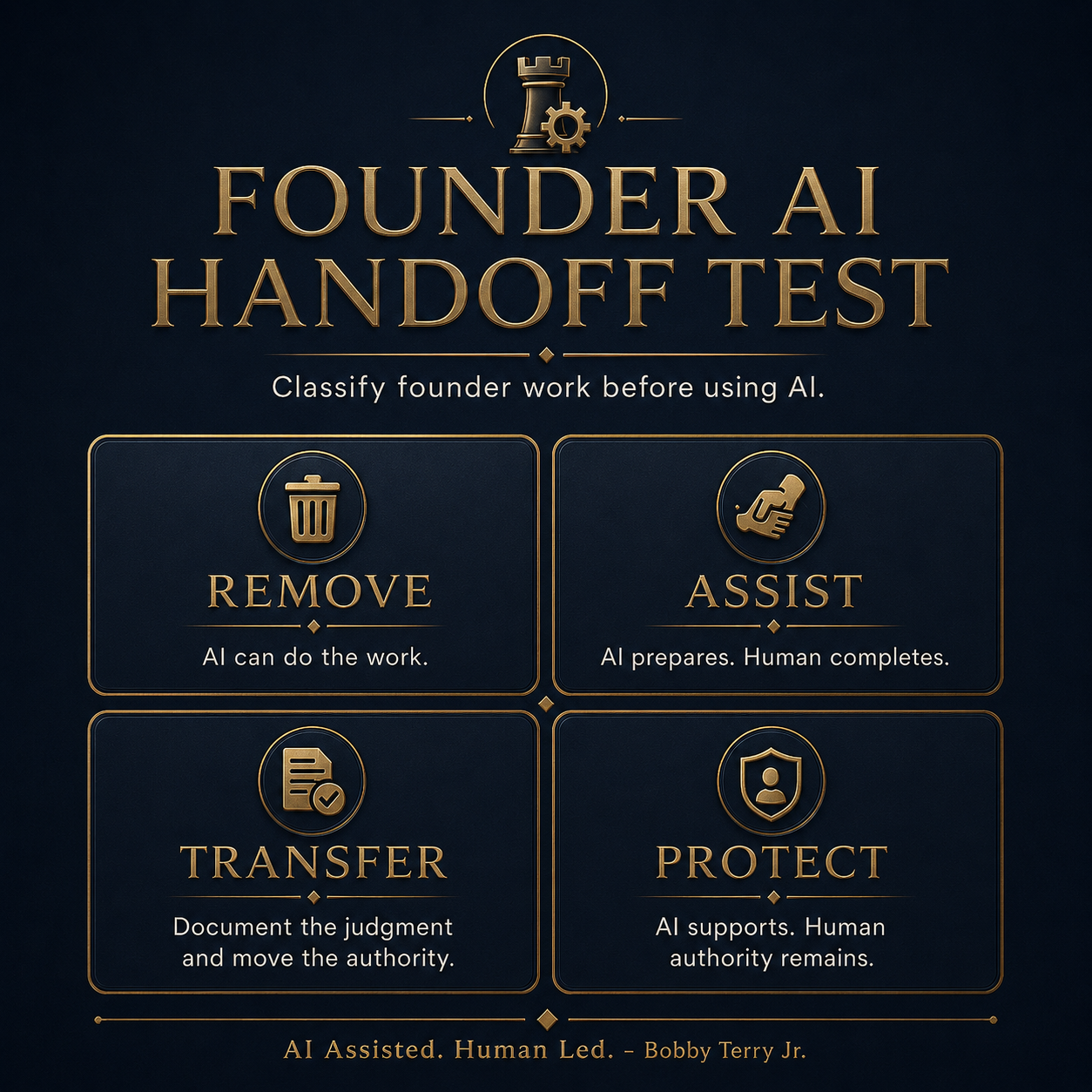
The Founder AI Handoff Test
Before moving a founder activity into AI, classify it into one of four categories:
1. REMOVE
The founder should not be doing the work.
AI or another system can complete it reliably without meaningful executive judgment.
Examples:
Routine information retrieval
Formatting
Basic categorization
Repetitive reporting
Standard summaries
Administrative preparation
Question:
"If the founder disappeared from this activity tomorrow, would the quality of the decision materially change?"
If not, remove the founder.
2. ASSIST
AI should prepare the work, but a human should complete the decision.
Examples:
Researching alternatives
Comparing scenarios
Preparing customer history
Identifying inconsistencies
Summarizing contracts or operating information for review
Building a first decision brief
Question:
"Can AI reduce the effort required without becoming the final authority?"
If yes, assist.
3. TRANSFER
The founder currently owns the decision, but someone else should eventually own it.
The bottleneck may exist because the founder's reasoning has never been converted into a usable operating rule.
Examples:
Routine customer exceptions below a defined threshold
Standard pricing decisions
Vendor approvals within established limits
Common operating escalations
Repeated decisions that already follow a recognizable pattern
The job is not merely to automate the task.
Capture the judgment.
Define the boundary.
Clarify the exceptions.
Move the authority closer to the person with the relevant information.
Question:
"Could another capable person make this decision if the founder's reasoning and boundaries were documented?"
If yes, transfer it.
4. PROTECT
The decision still requires appropriate human judgment or authority.
AI may help prepare it.
AI should not silently become the decision-maker.
Examples may include decisions involving:
Significant capital
Major strategic direction
Reputation
Critical relationships
High-consequence exceptions
Material risk
People whose lives or livelihoods may be affected
Commitments that are difficult to reverse
The appropriate decision-maker may be the founder, an executive, a licensed professional, a board, or another person with actual authority.
The important point is that the authority must be intentional.
Question:
"If this decision goes badly, who must be able to explain, defend, and own the judgment?"
That person cannot be replaced by "the AI said so."
Do not automate the bottleneck until you understand the bottleneck
This is the part I believe businesses can easily miss.
Automation can make a healthy process faster.
It can also make a broken process faster.
If the real problem is missing information, improve information flow.
If the real problem is unclear authority, define authority.
If the real problem is undocumented judgment, capture the reasoning.
If the real problem is unnecessary founder involvement, remove it.
If the decision genuinely requires executive judgment, protect the decision point.
That is why the Founder Decision Bottleneck framework starts by studying information and authority rather than assuming the founder needs to "let go."
The founder is not always the problem.
The routing may be.
AI should improve that routing instead of hiding it.
A practical example
Suppose a customer asks for an exception.
Today the request goes directly to the founder.
The founder opens the customer record.
Checks the history.
Looks at the financial effect.
Searches an old conversation.
Remembers how two similar situations were handled.
Asks the employee one more question.
Then makes the decision.
It appears that the founder is required.
But study the sequence.
Most of what happened before the final decision was information gathering.
AI may be able to prepare:
Customer history
Relevant policy
Previous comparable decisions
Financial impact
Missing information
Known exceptions
Recommended escalation level
Now the founder receives a decision-ready brief instead of an empty question.
That is a very different operating condition.
After enough repetitions, another pattern may become visible.
Perhaps every exception under a defined financial threshold follows the same reasoning.
Now that decision may no longer belong in the founder's ASSIST category.
It may be ready to TRANSFER.
The system is learning.
The founder dependency is shrinking.
And executive judgment remains available for the exceptions that actually deserve it.
What AI gave me back
My interest in AI has never been technology for technology's sake.
I care about what happens to the operation after the technology arrives.
Does information become easier to find?
Do decisions become clearer?
Does unnecessary work disappear?
Can someone move without waiting?
Is judgment being documented?
Are people gaining useful authority?
Is the founder spending more time on consequential decisions and less time rebuilding context?
That is the return I care about.
AI giving a founder "time back" is useful.
AI giving a founder decision capacity back is much more valuable.
The founder can use that capacity to observe.
Think.
Talk to customers.
Develop people.
Study risk.
Strengthen relationships.
Recognize changes earlier.
Make the decisions that actually require executive judgment.
That is what "AI Assisted. Human Led." means to me.
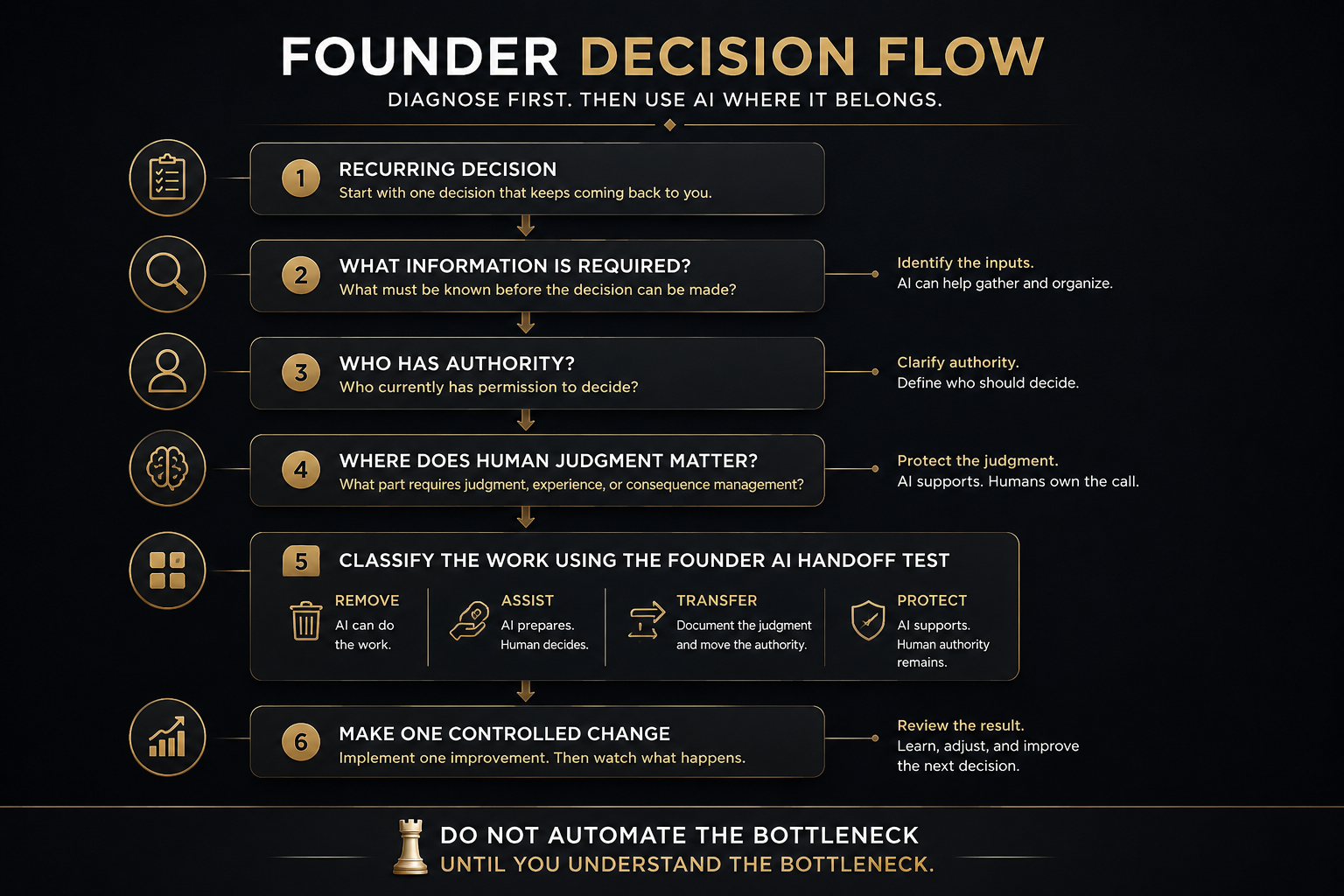
A five-step test for your operation
Pick one decision that repeatedly comes back to you.
Do not start with an AI tool.
Start with the decision.
Step 1: Reconstruct what happens
What information must be collected before you can decide?
Step 2: Identify the real authority
Who currently has permission to decide?
Who should have permission?
Step 3: Find the judgment
What part requires interpretation, experience, values, risk tolerance, or consequence management?
Step 4: Classify the work
Is it:
REMOVE?
ASSIST?
TRANSFER?
PROTECT?
Step 5: Make one controlled change
Do not redesign the entire company.
Remove one unnecessary founder dependency.
Then watch what happens.
Did the decision move faster?
Did quality hold?
Did people understand their authority?
Did another hidden dependency appear?
Use the answer to improve the next decision.
AI should reduce founder dependency, not founder responsibility
The future of an AI-enabled business should not be a founder approving everything.
It should not be an AI deciding everything either.
The stronger operating model sits between those extremes.
Routine work moves without unnecessary executive involvement.
Information reaches the right person earlier.
Recurring judgment becomes documented.
Authority moves closer to the work when appropriate.
AI prepares more decisions.
People make the decisions that still require accountability.
And executive attention becomes available for the situations where it creates the most value.
That is not removing the human.
It is making human judgment more deliberate.
Frequently asked questions
Can AI eliminate a founder bottleneck?
Sometimes AI can eliminate parts of the dependency, especially when the founder is repeatedly gathering information, preparing documents, retrieving context, or performing other routine work. But AI will not fix unclear authority, undefined decision boundaries, or undocumented judgment by itself.
What should founders avoid delegating completely to AI?
Do not automatically hand over consequential decisions simply because AI can produce a recommendation. Decisions involving meaningful risk, strategic direction, important relationships, people, reputation, or difficult-to-reverse commitments should have a clearly identified human authority point.
How do I know whether a founder task should be automated?
Separate the work from the judgment. Ask what information is being collected, what authority is required, what consequences exist, and whether the founder's reasoning materially changes the outcome. Then classify the activity as Remove, Assist, Transfer, or Protect.
Can AI help transfer decisions to employees?
Yes, when AI is used to capture and retrieve approved decision logic, thresholds, examples, and exceptions. But giving someone better information is not the same as giving that person authority. Decision rights still have to be made explicit.
What is the difference between AI assistance and AI authority?
AI assistance means the system helps gather, organize, compare, retrieve, or prepare information. Authority means having the legitimate responsibility to make and own the decision. Those are not the same thing.
The next decision
If every important decision keeps finding its way back to you, the first move is not necessarily another employee, another meeting, or another AI platform.
Study the route.
Find where information stops.
Find where authority stops.
Find where judgment actually matters.
Then decide what should be removed, assisted, transferred, or protected.
For the broader operating framework, read:
Founder Decision Bottleneck: Why Every Decision Comes Back to You
The goal is not to get the founder out of every decision.
The goal is to stop wasting founder judgment on decisions that no longer require it.